

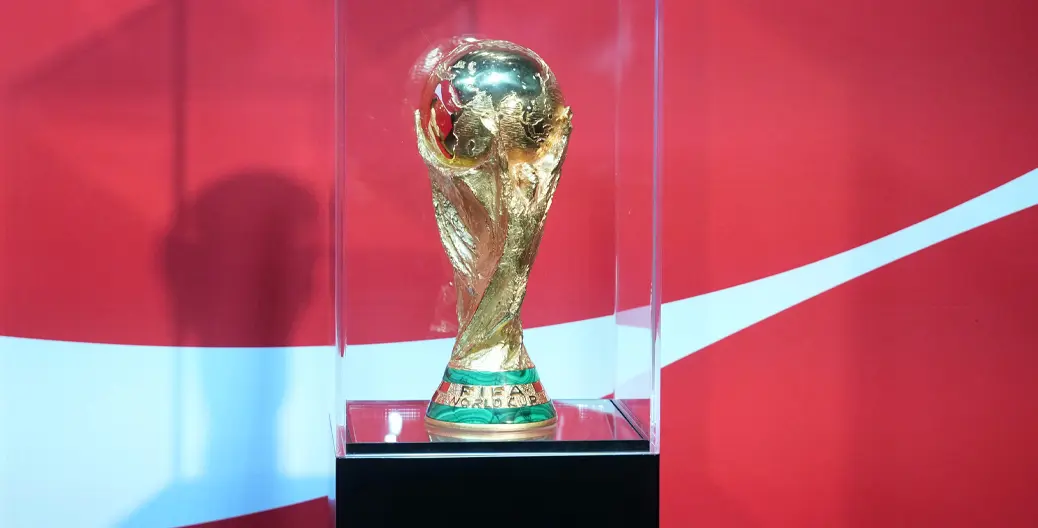
The FIFA World Cup 2026 is the 23rd edition of the tournament and represents the largest structural change in its history, with expansion in both scale and format. The tournament is scheduled from June 11 to July 19, 2026, spanning 39 days and featuring a record 104 matches.
The hosting structure is unprecedented, with three nations sharing duties: the United States, Canada, and Mexico. Matches will be played across 16 cities, including 11 in the United States, 3 in Mexico, and 2 in Canada.
The competitive format expands from 32 to 48 teams. The group stage consists of 12 groups of four teams, with each team playing three matches.
FIFA World Cup Facts and Format
- The top two teams in each group, along with the eight best third-place finishers, advance to a 32-team knockout stage.
- The knockout phase begins with a Round of 32, followed by a Round of 16, quarterfinals, semifinals, a third-place match, and the final.
- Key structural implications include a larger field with greater representation from all confederations, a longer tournament, and a significantly expanded knockout bracket compared to previous editions.
WORLD CUP 2026 FORMAT AND QUALIFICATION PROCESS
- The qualification process for the 2026 FIFA World Cup is organized by the six continental confederations under FIFA, with expanded allocation reflecting the 48-team format.
- A total of 46 spots are determined through qualification, while three host nations, the United States, Canada, and Mexico, receive automatic entry, leaving 43 direct qualification slots plus two additional places via intercontinental playoffs.
- Allocation by confederation is as follows. AFC receives 8 direct slots plus 1 playoff position. CAF receives 9 direct slots plus 1 playoff position.
- CONCACAF receives 3 direct slots plus 2 playoff positions, in addition to the three host nations already qualified. CONMEBOL receives 6 direct slots plus 1 playoff position. OFC receives 1 direct slot plus 1 playoff position. UEFA receives 16 direct slots with no guaranteed playoff place.
PAST WORLD CUP WINNERS
Since the inaugural FIFA World Cup in 1930, multiple nations have captured the title, with Uruguay winning the first tournament and repeating in 1950. Italy claimed four titles across 1934, 1938, 1982, and 2006, while Germany secured championships in 1954, 1974, 1990, and 2014. Brazil is the most successful, winning five times in 1958, 1962, 1970, 1994, and 2002. England won in 1966, Argentina in 1978, 1986, and 2022, and Spain in 2010. France claimed the title in 1998 and 2018.
- 2018 FIFA World Cup
France defeated Croatia 4–2 in the final.
- 2014 FIFA World Cup
Germany defeated Argentina 1–0 in the final.
- 2010 FIFA World Cup
Spain defeated the Netherlands 1–0 in the final.
- 2006 FIFA World Cup
Italy defeated France on penalties after a 1–1 draw.
- 2002 FIFA World Cup
Brazil defeated Germany 2–0 in the final.
- 1998 FIFA World Cup
France defeated Brazil 3–0 in the final.
PAST WORLD CUP TOP SCORERS
Historically, FIFA World Cup top scorers have often come from teams advancing deep into the tournament, combining individual finishing ability with team success. In 2022, Kylian Mbappé led with eight goals for France, while 2018’s top scorer was Harry Kane with six goals. James Rodríguez led the 2014 scoring with 6 goals, and in 2010, Thomas Müller scored 5. Earlier tournaments featured Miroslav Klose with five goals in 2006 and Ronaldo with eight in 2002.
- 2022 FIFA World Cup
Kylian Mbappé of France with 8 goals
- 2018 FIFA World Cup
Harry Kane of England with 6 goals
- 2014 FIFA World Cup
James Rodríguez of Colombia, with 6 goals
- 2010 FIFA World Cup
Thomas Müller of Germany with 5 goals
- 2006 FIFA World Cup
Miroslav Klose of Germany with 5 goals
- 2002 FIFA World Cup
Ronaldo of Brazil with 8 goals
Top 2026 FIFA World Cup Dream Matchups
- Argentina vs France
Rematch of the 2022 final, featuring the most recent champion against the previous runner-up, with both sides maintaining elite attacking depth and continuity at key positions.
- Brazil vs Germany
Historically significant matchup revisiting multiple World Cup meetings, including the 2014 semifinal, with both programs consistently ranking among the most successful in tournament history.
- England vs Spain
A clash between two possession-oriented systems, with Spain’s technical midfield structure contrasted against England’s depth across attacking and defensive lines
FIFA World Cup Betting Tips
- World Cup Betting strategy should focus on tournament structure, pricing inefficiencies, and matchup variance rather than outright picks alone.
- Outright futures value is strongest when targeting teams outside the top two favorites. Spain and England are priced at peak market levels, limiting return on investment. Teams such as France, Brazil, and Argentina offer a more balanced risk-to-price ratio due to proven knockout-stage performance and squad depth.
- Group stage betting requires emphasis on variance control. The expanded 48-team format introduces more mismatches, increasing the likelihood of heavy favorites winning but also creating inflated lines. Underdog value emerges when elite teams rotate squads after early qualification or manage goal differential rather than margin.
- Structural changes, market behavior, and tournament-specific variance drive Caution for 2026 FIFA World Cup bettors.
- The expansion to 48 teams increases uncertainty. More lower-ranked teams enter the field, creating uneven group-stage matchups and introducing volatility due to limited historical data on cross-confederation competition. Early-round results can be less predictable than prior 32-team formats.
- Market inflation is a consistent risk. Public betting heavily concentrates on traditional powers such as Brazil, France, England, and Argentina, often pushing odds below true probability. This reduces long-term value on favorites, particularly in outright winner markets.
Frequently Asked Questions
The most popular types of bets for the FIFA World Cup include outright winner bets, group winner bets, and top goalscorer markets. Outright winner bets involve selecting the team expected to win the tournament and are heavily traded before and during the event.